When Should You Claim Social Security? The Decision That Could Cost You $100,000
The age you claim Social Security is one of the biggest money decisions you will make in retirement. Claim at 62 and your check is permanently smaller. Wait until 70 and it is permanently larger. For many people, the gap between those two choices can exceed $100,000 in lifetime benefits, and for married couples the stakes are even higher because the decision also sets the survivor benefit.
There is no single right age. It depends on your health, other income, work and marriage. Here is each piece.
The Short Answer
- Age 62 is the earliest you can claim. If your full retirement age is 67, your check is reduced by 30% for life.
- Full retirement age (FRA) is 67 for anyone born in 1960 or later. You get 100% of your earned benefit.
- Age 70 is the latest that makes sense to wait. Your benefit grows 8% for each year you delay past FRA, so a 67 FRA becomes 124% at 70.
Why This Decision Is So Permanent
Once you start collecting and pass the 12-month withdrawal window, you are locked into that benefit amount for life. Every cost-of-living adjustment after that is applied to your reduced (or increased) base, so the difference between claiming early and claiming late compounds over decades.
Social Security does allow one do-over. You can withdraw your application within 12 months of approval, but only once, and you must pay back everything you and your family received, including any Medicare premiums and taxes that were withheld. After that window closes, the main option left is to suspend benefits once you reach full retirement age, which lets you earn delayed credits until 70. Suspending also stops any benefits paid to family members on your record, except a divorced spouse.
Full Retirement Age by Birth Year
Your FRA is the age when you get 100% of your benefit. It depends on the year you were born (SSA):
| Year of birth | Full retirement age |
|---|---|
| 1943 to 1954 | 66 |
| 1955 | 66 and 2 months |
| 1956 | 66 and 4 months |
| 1957 | 66 and 6 months |
| 1958 | 66 and 8 months |
| 1959 | 66 and 10 months |
| 1960 and later | 67 |
Most people reading this today were born in 1960 or later, so the examples below use an FRA of 67.
How the Reduction and Credits Actually Work
Claiming early. Social Security cuts your benefit by 5/9 of 1% for each of the first 36 months you claim before FRA, then 5/12 of 1% for each month beyond that (SSA). With an FRA of 67, claiming at 62 is 60 months early, which works out to a 30% permanent reduction.
Waiting past FRA. For anyone born in 1943 or later, each year you delay past FRA adds 8% (2/3 of 1% per month). Credits stop at 70, so there is no reason to wait longer than that.
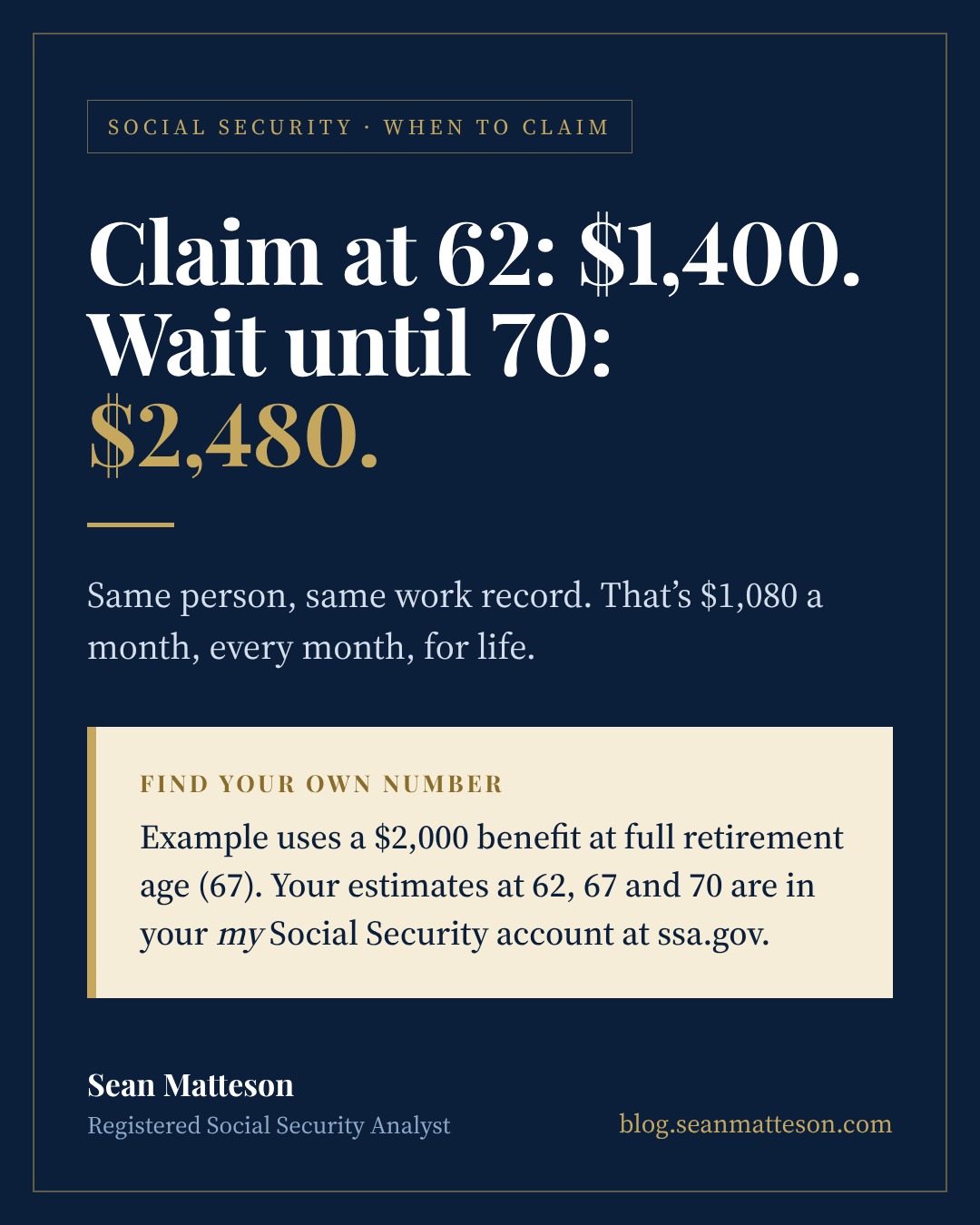
If your full benefit at 67 would be $2,000 per month, here is what that looks like:
| Claiming age | Monthly benefit | Annual benefit | vs. full benefit |
|---|---|---|---|
| 62 | $1,400 | $16,800 | -30% |
| 64 | $1,600 | $19,200 | -20% |
| 67 (FRA) | $2,000 | $24,000 | Full benefit |
| 70 | $2,480 | $29,760 | +24% |
Figures before cost-of-living adjustments. Your own numbers depend on your earnings record.
The Break-Even Idea (A Hypothetical Example)
The break-even age is the point where waiting finally pays off. Before it, the person who claimed early is ahead in total dollars. After it, the person who waited pulls ahead and stays ahead for the rest of their life.
Hypothetical example. Use the same $2,000 full benefit at 67. To keep the math simple, this ignores cost-of-living adjustments, taxes and investment returns.
- 62 vs. 67. By 67, the early claimer has collected 60 checks of $1,400, or $84,000. From then on, the FRA claimer gets $600 more per month. $84,000 / $600 = 140 months, or about 11 years and 8 months. Break-even is around age 78 and 8 months.
- 67 vs. 70. The person who waits gives up 36 checks of $2,000, or $72,000. After 70, they get $480 more per month. $72,000 / $480 = 150 months. Break-even is around age 82 and 6 months.
- 62 vs. 70. By 70, the early claimer has collected 96 checks of $1,400, or $134,400. The age-70 check is $1,080 higher. Break-even is around age 80 and 4 months.
Now stretch it out. If this person lives to 90, claiming at 62 pays about $470,400 in total. Claiming at 70 pays about $595,200. That is a difference of roughly $124,800, which is where the “$100,000 decision” comes from.
“The break-even analysis tells you when waiting pays off mathematically. But the real question is: how long will you live, and how much risk can you absorb if you’re wrong?”
Break-even is a starting point, not the final answer. The bigger check matters most in the years when other savings may be running low.
Spousal Benefits
If you are married, your claiming age affects more than your own check.
- A spouse can receive up to 50% of the worker’s full retirement age benefit (SSA).
- The worker must already be receiving benefits before the spouse can collect on that record.
- If the spouse claims before their own FRA, the spousal benefit is reduced. At 62 with an FRA of 67, the reduction is 35%, so a $500 spousal benefit becomes $325 (SSA).
- Delayed credits do not raise the spousal benefit. It tops out at 50% of the worker’s FRA amount, even if the worker waits to 70.
- A divorced spouse may qualify on an ex-spouse’s record if the marriage lasted at least 10 years.
The practical takeaway: a spouse gains nothing by waiting past their own FRA to take a spousal benefit.
Survivor Benefits: Why the Higher Earner’s Age Matters Most
This is where couples leave the most money behind. When one spouse dies, the survivor keeps the larger of the two checks, not both. That means the higher earner’s claiming age effectively sets the survivor’s income for the rest of their life.
- Unlike spousal benefits, survivor benefits are based on the higher amount the deceased was receiving, including delayed credits (SSA).
- A widow or widower can start survivor benefits as early as age 60 (50 if disabled), at a reduced amount (SSA).
- Survivor payments start at 71.5% of the deceased spouse’s benefit and rise to 100% at the survivor’s full retirement age (SSA).
- A survivor who also has their own work record can take one benefit first and switch to the other later, for example taking survivor benefits early and switching to their own retirement benefit at 70.
If the higher earner claims at 62, the survivor may live decades on a check cut by 30%.
Working While Collecting: The Earnings Test
If you claim before full retirement age and keep working, Social Security may hold back part of your benefit. These are the limits from the SSA’s retirement earnings test table:
| Situation | 2026 limit | 2027 limit | What gets withheld |
|---|---|---|---|
| Under FRA all year | $24,480/year | $25,560/year | $1 for every $2 above the limit |
| Year you reach FRA (months before FRA) | $65,160/year | $67,920/year | $1 for every $3 above the limit |
| Month you reach FRA and later | No limit | No limit | Nothing |
Two things people miss:
- The money is not lost. Once you reach FRA, Social Security recalculates your benefit to credit you for the months that were withheld.
- Claiming at 62 on a full salary often makes little sense: you lock in the reduction and much of the check may be withheld.
Taxes on Your Benefits
Up to 85% of your Social Security can be subject to federal income tax, depending on your “combined income.” The IRS calculates it as half of your Social Security benefits plus all your other income, including tax-exempt interest (IRS).
| Filing status | Up to 50% may be taxable above | Up to 85% may be taxable above |
|---|---|---|
| Single, head of household, qualifying surviving spouse | $25,000 | $34,000 |
| Married filing jointly | $32,000 | $44,000 |
| Married filing separately, lived with spouse during the year | $0 | $0 (up to 85%) |
Sources: IRS Social Security income FAQ and IRS tax tip on taxable benefits. These thresholds are set in law and are not indexed for inflation, so more retirees cross them every year.
New for tax years 2025 through 2028: taxpayers 65 and older can take an extra deduction of up to $6,000 each ($12,000 for a married couple if both qualify). It phases out above $75,000 of modified adjusted gross income for single filers and $150,000 for joint filers (IRS). It does not exempt Social Security from tax, but it can lower the tax you owe. Talk to a tax professional about your own return.
Claiming while you still have wages or large IRA withdrawals can push more of your benefit into the taxable range.
The Most Common Mistakes
- Claiming at 62 simply because you can, without running the numbers for your specific situation
- Both spouses claiming at the same age without considering the survivor benefit implications
- Not checking your Social Security earnings record at ssa.gov for errors that understate your benefit
- Ignoring divorced or survivor spousal benefits you may be entitled to
- Claiming early while still working and triggering the earnings limit withholding
How to Decide
Work through these questions in order:
- Get your real numbers (see below) and check your earnings history for missing years.
- Be honest about health and family history. If you have serious health issues, claiming earlier can make sense. If your parents lived into their 90s, waiting usually pays.
- If you are married, plan around the higher earner. That check becomes the survivor’s check.
- Look at your other income. If you are still working before FRA, check the earnings test. If you have savings to bridge the gap, delaying may be affordable.
- Check the tax picture. Combined income above the IRS thresholds means more of each check goes to taxes.
- Decide with both the break-even age and the “what if I live to 95” scenario in mind.
How to Get Your Number
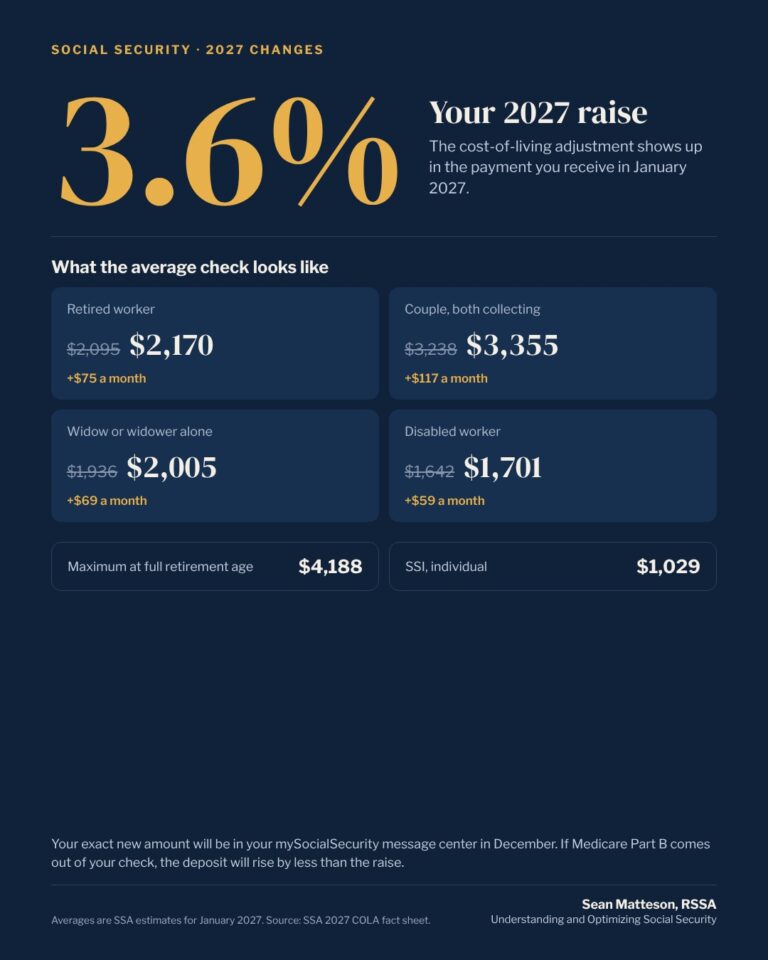
The starting point for any Social Security analysis is your actual estimated benefit at ssa.gov/myaccount. Your statement shows your estimated monthly benefit at 62, at your Full Retirement Age, and at 70. Before you log in, read our guide on setting up your Social Security account securely. If you are leaning toward claiming early, read Filing for Social Security at 62 first, and see Social Security in 2027: What’s Changing for next year’s figures.
Get Free Help in the Facebook Group
Have a question about your own claiming decision? Join my free Facebook group, Social Security Help & Guidance. Ask questions, see real examples and get straight answers on Social Security rules, with no sales pitch.
Want a personalized Social Security analysis? Text SSA to 702-605-6038 and Sean will follow up personally.
Frequently Asked Questions
There is no single best age. Claiming at 70 gives the largest check for life. Claiming at 62 gives you money sooner but at a 30% permanent reduction if your FRA is 67. Your health, marriage and other income decide which is right for you.
For anyone born in 1943 or later, your benefit grows 8% for each full year you wait past full retirement age. With an FRA of 67, waiting to 70 gives you 124% of your full benefit.
Yes, once. You can withdraw your application within 12 months of approval, but you must repay everything you and your family received. After FRA, you can also suspend benefits to earn delayed credits until 70.
Not the spousal benefit. It is capped at 50% of your full retirement age amount. But the survivor benefit does go up, because it is based on what you were actually receiving, including delayed credits.
In 2026, $24,480 a year before $1 is withheld for every $2 over. In the year you reach FRA, the limit is $65,160 ($1 for every $3 over). For 2027 those limits are $25,560 and $67,920. After you reach FRA there is no limit.
It can be. If half your benefits plus your other income is over $25,000 (single) or $32,000 (married filing jointly), up to 50% may be taxable, and above $34,000 or $44,000, up to 85%.
About Sean Matteson
Sean Matteson is a Registered Social Security Analyst and Licensed Insurance Agent since 2006. He helps pre-retirees across the country build Social Security claiming strategies that maximize lifetime income. Based in Las Vegas, NV.
This content is for educational purposes only and is not legal, tax, or individualized financial advice. Social Security rules are subject to change. Individual benefit amounts vary based on earnings history and claiming age.